Field Guide
0-Day Protection: How CVE Pattern Scanning Catches Vulnerabilities in AI Agent Code
AI agents write code, execute code, and process code from tool responses. Every one of those interactions can carry known vulnerability patterns. CVE pattern scanning catches them before they execute.
Published March 2026 · ~10 min read
The Problem
LLMs Reproduce Vulnerabilities. That Is Not a Bug — It Is a Feature of How They Were Trained.
Large language models learned to write code by reading billions of lines of it. A meaningful percentage of that training data contained security vulnerabilities — SQL injection, path traversal, insecure deserialization, command injection, hardcoded credentials. The model did not learn these were wrong. It learned they were common.
When an AI agent generates code through an MCP tool call, it will reproduce these patterns. Not always, not intentionally, but predictably. Ask an agent to write a database query and there is a non-trivial chance it produces string interpolation instead of parameterised queries. Ask it to handle file paths and it may not sanitise for traversal. Ask it to deserialise data and it may reach for pickle.loads() or yaml.unsafe_load().
The problem is bidirectional. When an agent calls a tool and receives a response containing code — a file read, a search result, a code generation output — that response may itself contain vulnerability patterns. The agent then acts on that code, potentially executing it, embedding it in further tool calls, or passing it to other agents in a mesh.
This is not theoretical. Every production MCP deployment we have audited has had instances of agents generating or processing code that matched known CVE patterns. The question is not whether it happens, but whether you catch it when it does.
The Approach
Pattern Matching Against Real-World Security Research
CVE pattern scanning is not static analysis. It does not build an AST, resolve dependencies, or trace data flow. It does something simpler and faster: it matches code fragments against a database of vulnerability signatures extracted from real CVEs.
Every CVE that involves a code-level vulnerability has a pattern — the specific construct that makes code exploitable. Sometimes it is a function call (pickle.loads() on untrusted input). Sometimes it is a structural pattern (string formatting into a SQL query). Sometimes it is a known-dangerous configuration (verify=False on an HTTP request). These patterns are extractable, indexable, and matchable at speed.
The key insight is that you do not need to understand the full program semantics to catch most vulnerability classes. You need to recognise the patterns that security researchers have already identified and catalogued. The CVE database is, in effect, a crowd-sourced collection of "code that should never appear in production" — and you can match against it at the speed of a tool call.
Architecture
Real-Time Scanning Inside the MCP Pipeline
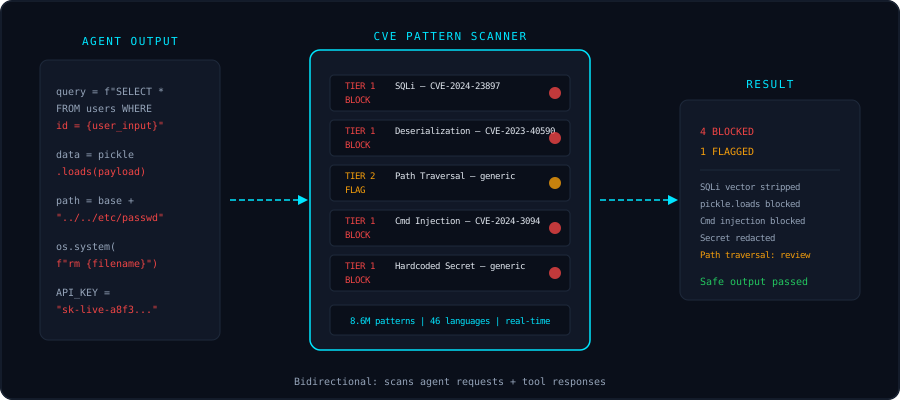
In an MCP deployment, CVE pattern scanning sits inline on the tool call path — not as a sidecar, not as a batch job, but as a synchronous step in every tool invocation. When an agent sends a tool call, the scanner inspects the arguments before they reach the target server. When a tool returns a response, the scanner inspects the content before it reaches the agent.
Bidirectional by design. Outbound scanning catches vulnerabilities the agent is trying to introduce — SQL injection in a database query, command injection in a shell command. Inbound scanning catches vulnerabilities arriving from tool responses — malicious code in a file read, exploit payloads in search results, poisoned code snippets from a compromised server.
Pattern risk tiering. Not every match warrants the same response. Tier 1 patterns are vendor-prefixed, CVE-specific signatures that are dangerous in any context — these block immediately and the tool call is rejected. Tier 2 patterns are generic constructs (string interpolation into queries, unsanitised path concatenation) that are suspicious but context-dependent — these are flagged for review and logged, but the call proceeds.
Latency budget. Inline scanning must be fast enough that agents do not time out waiting for tool responses. Pattern matching against a pre-compiled signature database operates in single-digit milliseconds for typical payloads. The scanner adds less overhead than TLS negotiation on a cold connection.
Detection Categories
What Kinds of Patterns Get Caught
Limitations of Traditional Tools
Why SAST and DAST Cannot Solve This Problem
Static Application Security Testing runs at build time. Dynamic Application Security Testing runs at deploy time or against a running application. Neither operates where MCP traffic lives: at runtime, inside the tool call path, on code that was generated seconds ago and may never be persisted to a file.
When an AI agent generates a SQL query through a tool call, that query exists only as a string in a JSON payload. It is not in a source file. It is not in a repository. It will never be committed. SAST will never see it. By the time DAST could detect the resulting vulnerability, the agent has already executed the query, processed the results, and moved on to the next task.
The temporal gap is the vulnerability. Traditional security tools operate on a build-test-deploy cycle that assumes code is written by humans, reviewed by humans, and deployed on a predictable schedule. MCP traffic breaks every one of those assumptions. Code is generated in milliseconds, executed immediately, and may flow through multiple agents before any human reviews it.
This does not mean SAST and DAST are irrelevant — they remain essential for application security. But they cover a different surface. MCP tool call traffic is a new surface that requires inline, real-time scanning. Anything less is a gap in coverage.
The Database
8.6 Million Patterns. 46 Languages. Continuously Growing.
Effective pattern scanning requires a database that reflects the real world, not a hand-curated list of the top 50 vulnerability patterns. mistaike's Bug Vault indexes over 8.6 million real-world error and vulnerability patterns extracted from open-source codebases across 46 programming languages.
These patterns are sourced from real commit diffs — the actual code changes where developers fixed vulnerabilities. Each pattern captures both the vulnerable construct and the context in which it appeared, enabling more precise matching than generic regex rules. When a new CVE is published and a fix is committed to an open-source project, the pattern database grows automatically.
This matters because vulnerability patterns are language-specific and framework-specific. A SQL injection in Django looks different from one in Express.js. A path traversal in Go's filepath.Join() has different characteristics than one in Python's os.path.join(). Broad coverage across languages and frameworks is not optional — it is the difference between catching the vulnerability and missing it.
AI agents are polyglot by nature. A single agent session might generate Python, invoke a JavaScript tool, process a SQL response, and read a YAML config file. The scanner must match patterns across all of these. A monolingual pattern database is a false sense of security.
Related Reading
Continue Reading
MCP Security Best Practices: The 2026 Field Guide
The comprehensive reference for securing MCP deployments end-to-end.
The OWASP MCP Top 10 Explained
All 10 risk categories broken down with mitigations.
AI Agent DLP: Preventing Data Exfiltration Through MCP
Why traditional DLP is blind to MCP traffic and what to do about it.
Prompt Injection vs Tool Poisoning: MCP's Two Biggest Threats
Clear distinction between the two attack classes with defence strategies.
The Real MCP Attack Surface
Visual map of the full attack surface across config, transport, and memory.
Try It
Scan Your Agent's Tool Calls Against 8.6M+ Patterns
Connect your MCP server to mistaike in under 2 minutes. Every tool call scanned for known CVE patterns. Free tier, no credit card.