MCP Security Guide
MCP Memory and Vaults:
Why Context Management Is a Security Feature
Most teams treat agent memory as a productivity feature. It is. But unstructured memory is also an unmonitored data store with no access controls, no expiry, and no audit trail. That makes it a security problem.
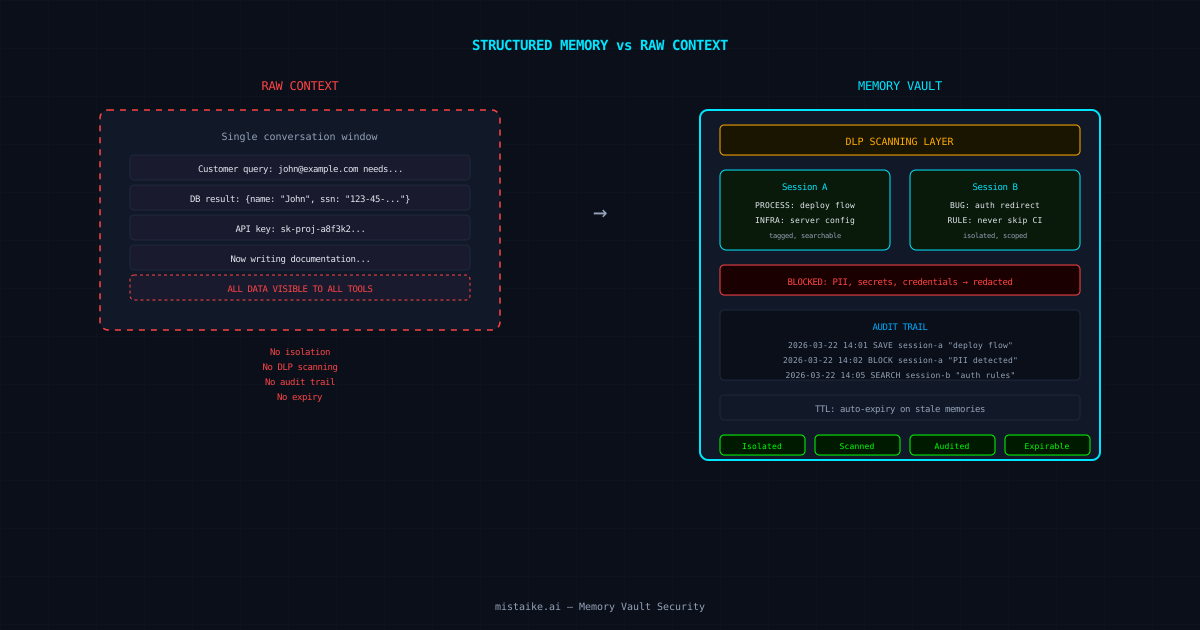
The Raw Context Problem
When an AI agent accumulates context — tool outputs, file contents, API responses — that context sits in the conversation window. It is not encrypted. It is not scoped. It is not auditable. Any tool the agent calls can see everything that came before it in the session.
This means a database query result containing customer emails is visible to every subsequent tool call. A secret accidentally printed in a stack trace persists for the entire session. And when sessions are saved or exported, that data goes with them.
Structured memory solves this by moving persistent knowledge out of the raw context window and into a purpose-built store with proper controls.
Control 1
Session Isolation
A memory vault enforces boundaries between sessions. When an agent starts a new task, it does not automatically inherit every piece of data from the previous one. It queries the vault for what it needs, and the vault decides what to return based on access policies.
This matters because agent sessions are not like human conversations. An agent might handle a support ticket containing PII, then switch to writing documentation. Without session isolation, the PII leaks into the documentation context.
# Without vault: everything bleeds
Session A: reads customer DB → PII in context
Session A: writes docs → PII still in context
# With vault: explicit retrieval
Session B: search_memories("doc conventions")
→ Returns only documentation patterns
→ Customer PII never enters this session
Control 2
DLP on Stored Memories
When memories are saved to a vault, they pass through Data Loss Prevention scanning. Secrets, credentials, PII, and other sensitive data can be detected and either redacted or blocked before they reach persistent storage.
This is fundamentally different from scanning conversation logs after the fact. DLP at the vault boundary prevents sensitive data from being stored in the first place, eliminating an entire class of data retention problems.
Secrets detection — API keys, tokens, passwords, and connection strings are caught before they are persisted
PII scanning — Email addresses, phone numbers, and other personal data are flagged or redacted
Custom patterns — Organisation-specific sensitive data (internal project names, codenames, customer IDs) can be added to the DLP ruleset
Control 3
Searchable Audit Trails
Every memory operation — save, search, retrieve, delete — is logged. Not just that it happened, but who triggered it, what was stored, when it was accessed, and by which session.
This gives you something raw conversation logs cannot: the ability to answer “has any agent ever stored or accessed data about customer X?” in seconds, across all sessions, all agents, all time.
For regulated industries — finance, healthcare, government — this is not optional. It is the difference between “we think our agents are compliant” and “here is the audit log proving it.”
Security That Makes You Faster
The best part about structured memory is that the security controls also make agents more effective. Session isolation means agents start with relevant context instead of drowning in irrelevant history. DLP scanning means you can trust what is in the vault. Audit trails mean you can debug agent behaviour without replaying entire conversations.
Teams using memory vaults report faster agent startup times, fewer hallucinations from stale context, and dramatically easier debugging. Security and productivity are not in tension here — they reinforce each other.
What Good Looks Like
Structured over raw
Memories are tagged, categorised, and searchable. Not “dump everything into a text file.”
Scoped retrieval
Agents query for what they need and get back only what matches. No global context dump.
DLP at the boundary
Sensitive data is caught on write, not discovered in a quarterly audit.
Expiry and rotation
Memories have TTLs. Stale data is automatically purged. No infinite accumulation.
mistaike.ai’s Memory Vaultprovides session-isolated, DLP-scanned, fully auditable memory for MCP agents. It works with Claude Code, Cursor, and any MCP-compatible client.
← All guides