The Gap
Why MCP Needs Its Own Governance
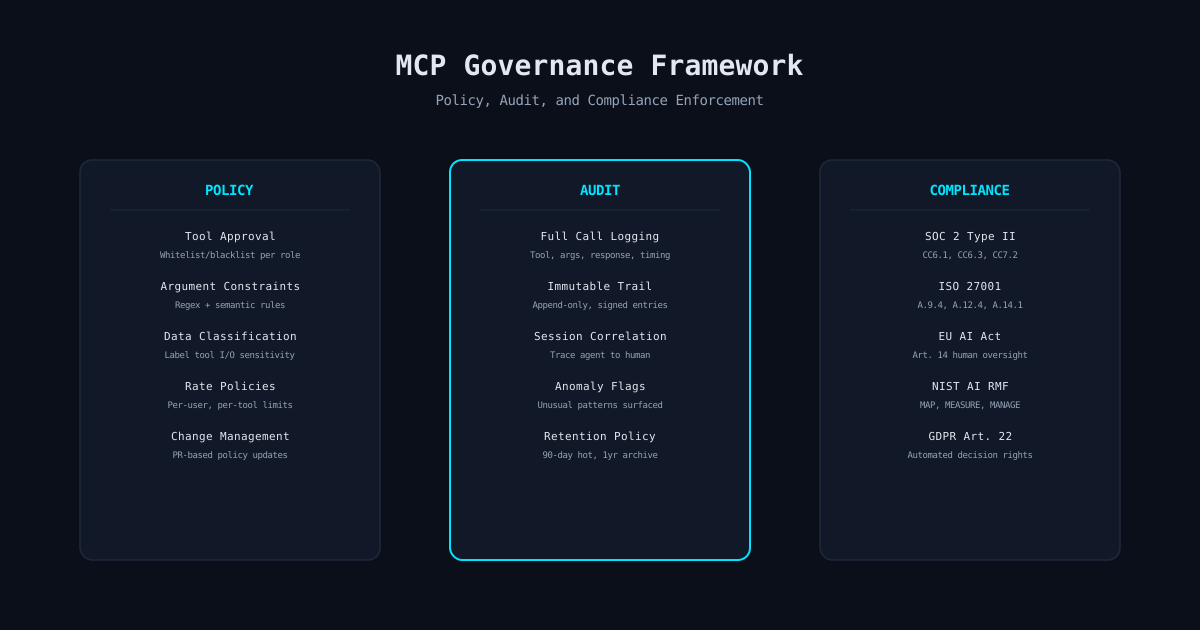
Enterprises have governance frameworks for cloud services, SaaS applications, and API integrations. They have change management boards, access reviews, and audit requirements. None of these frameworks account for AI agents making autonomous tool calls through MCP.
MCP is not an API. It is a protocol that lets AI agents dynamically discover and invoke tools. The agent decides which tools to call, what arguments to pass, and how to chain calls together. This is a fundamentally different access pattern than a human clicking buttons in a SaaS application or a service calling a fixed set of API endpoints.
Without MCP-specific governance, you have AI agents making unrestricted tool calls with no approval process, no audit trail, and no compliance mapping. That is not a technical debt item. That is a material control gap.
Pillar One
Tool Approval Workflows
Every MCP tool available to agents must go through an approval process before it enters production. This is the equivalent of vendor onboarding for SaaS tools, but applied at the individual tool level.
Tool Registration
Every MCP server and individual tool is registered in a central catalog with metadata: purpose, data classification, owner, risk tier.
Security Review
Security team reviews what data the tool can access, what actions it can perform, and what the blast radius of misuse looks like. Tools that can write to external systems or access sensitive data get deeper review.
Risk Classification
Each tool is assigned a risk tier. Tier 1 (read-only, non-sensitive) can be auto-approved. Tier 2 (write access, internal data) requires team lead approval. Tier 3 (external access, sensitive data) requires security sign-off.
Policy Binding
Approved tools get bound to policies that define who can use them, what arguments are allowed, what rate limits apply, and what DLP rules are enforced.
Periodic Review
Tool approvals expire. Quarterly review of all approved tools: usage patterns, incidents, policy violations. Tools with no legitimate usage are decommissioned.
Pillar Two
Audit Trail Requirements
Every MCP tool call must produce an audit record. Not a log line in a general application log. A structured, immutable audit entry that can answer the questions your auditor will ask.
# Required audit fields per tool call
{
  "timestamp": "2026-03-22T14:32:01.847Z",
  "session_id": "sess_abc123",
  "user_id": "[email protected]",
  "agent_id": "claude-opus-4-20250514",
  "tool_server": "github-mcp",
  "tool_name": "create_comment",
  "arguments_hash": "sha256:a1b2c3...",
  "response_hash": "sha256:d4e5f6...",
  "dlp_result": "clean",
  "policy_decision": "allow",
  "latency_ms": 142,
  "data_classification": "internal",
  "correlation_id": "trace_xyz789"
}
Note the argument and response hashes. Full content is stored separately with access controls. The audit trail references content by hash, enabling tamper detection without exposing sensitive data in the audit log itself.
Retention Policy
90 days hot storage for active investigation. One year warm archive for compliance. Seven years cold archive for regulated industries. All immutable, all signed.
Access Controls
Audit logs are append-only. No one can modify or delete entries. Read access requires justification. Full content access requires security team approval.
Pillar Three
Compliance Mapping
MCP governance does not exist in a vacuum. It maps directly to existing compliance frameworks. Here is how MCP controls satisfy specific control requirements:
SOC 2 Type II
CC6.1 — Logical Access
Per-tool authorization policies. Tool allowlisting per role. Scoped credentials per session.
CC6.3 — Access Removal
Session expiry with automatic credential revocation. Quarterly tool approval review with decommissioning.
CC7.2 — Monitoring
Real-time audit trail on all tool calls. Anomaly detection on tool call patterns. Automated alerting on policy violations.
ISO 27001
A.9.4 — System Access Control
Least-privilege tool access. Per-session scoping. Continuous authorization verification.
A.12.4 — Logging and Monitoring
Immutable audit trail. Structured log entries. Correlation across sessions and users.
A.14.1 — Security Requirements
Tool registration and security review. Risk classification. Policy binding before production use.
EU AI Act
Art. 14 — Human Oversight
Tool approval workflows require human review. High-risk tools require security sign-off. Override capability on any automated decision.
Art. 13 — Transparency
Full audit trail of agent actions. Session correlation to human user. Explainable policy decisions.
Art. 9 — Risk Management
Tool risk classification. Continuous monitoring. Incident response procedures for MCP security events.
Change Management
Policy as Code
MCP governance policies should be managed as code, not as wiki pages or spreadsheet entries. Policy files live in version control. Changes go through pull requests. Every policy change has an author, a reviewer, a timestamp, and a reason.
This is not aspirational. It is a requirement for auditability. When your auditor asks who approved the change that allowed agents to access the customer database, you show them a merged pull request with a security team approval, not a Jira ticket from six months ago.
# policies/production/database-access.yaml
# Last changed: PR #247, approved by: security-team
# Reason: Engineering needs read access for debugging

tool: database.query
roles: [senior-engineer, on-call]
constraints:
  read_only: true
  max_rows: 100
  blocked_tables: [users.credentials, billing.payment_methods]
  require_where_clause: true
dlp:
  scan_response: true
  mask_fields: [email, phone]
audit:
  log_full_query: true
  log_response_hash: true
  alert_on: [blocked_table_attempt, large_result_set]
review:
  next_review: "2026-06-22"
  owner: security-team
For Security Leaders
The Board-Level Question
The question your CISO will eventually face from the board is simple: “How do we control what our AI agents can do?” The answer needs to be equally simple: “Every tool is approved, every call is logged, every policy is enforceable, and we can prove it.”
MCP governance is not a technical project. It is a risk management program that happens to require technical implementation. The governance framework comes first. The tooling supports the framework. Getting this backwards, deploying monitoring tools without a governance model, gives you dashboards without decisions.
mistaike.ai
Governance-Ready MCP Security
mistaike.ai provides the policy engine, audit trail, and compliance reporting your governance framework requires. Tool approval, enforcement, and evidence generation in one platform.
See How It Works